How to Accept Stablecoin Payments as a Business
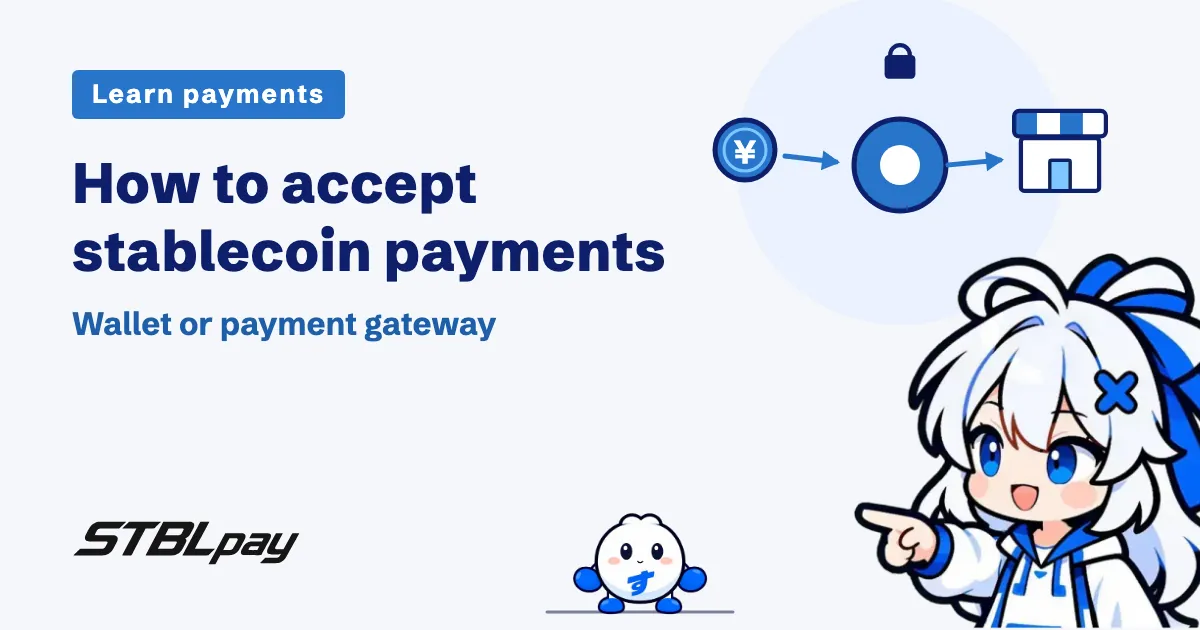
Accepting stablecoin payments means letting customers pay with a stablecoin, a digital token designed to keep a steady value, usually tied one-to-one to a legal currency. A business receives the tokens in one of two ways: in a wallet it controls, or through a payment gateway or processor. Some processors convert the tokens into local currency for you[1]. A final blockchain transfer cannot be undone, so there is no card-style chargeback, and refunds are sent back by the merchant[4]. This guide compares the two approaches, lists the steps to start and the costs and risks to check, and explains where a yen stablecoin such as JPYC fits when you sell to customers in Japan.
What does it mean to accept stablecoin payments?
A stablecoin is a digital token designed to keep a steady value, usually tied one-to-one to a legal currency such as the US dollar or the Japanese yen. It moves over a blockchain, a shared record of transactions that is hard to change after the fact. To accept stablecoin payments, a business lets the customer send tokens from their own crypto wallet and then receives them, either directly or through a service that handles the payment page and the settlement.
The details depend on the provider. Stripe's stablecoin payments docs, for example, describe customers choosing their stablecoin currency, wallet and network, and completed payments settling in the merchant's Stripe balance in local currency[1]. Another provider may pay out the tokens as they are, or work differently again.
Stablecoin payment gateway or your own wallet: which should a business use?
A stablecoin payment gateway, also called a stablecoin payment processor, is a service that sits between your checkout and the blockchain. It shows the buyer a stablecoin checkout page, confirms that the transfer arrived, and reports the sale to you.
There are two broad approaches. With a self-hosted wallet, you create a wallet, show its address (or a unique address per order) at checkout, and watch the blockchain for incoming transfers. With a stablecoin payment gateway or processor, a provider supplies the checkout, confirms payments and reports them to you. These are general tendencies. Actual terms depend on the provider you choose.
| Item | Self-hosted wallet | Payment gateway or processor |
|---|---|---|
| Checkout | You build it: show the address, match each transfer to an order | The provider supplies hosted or embeddable checkout[1] |
| Keys and funds | You hold and protect the private keys | Depends on the provider; read its terms on custody |
| Conversion to local currency | You arrange it yourself, for example through an exchange | Some providers settle in local currency[1] |
| Refunds | You send tokens back yourself | Often a refund flow in the provider's tools; with Stripe, refunds go back as stablecoins to the customer's wallet[1] |
| Records and reporting | You keep your own records of every transfer | The provider's reports help, but you remain responsible for your books |
| Setup effort | Higher: development, monitoring and key management | Lower: configuration and testing |
Neither approach is better for everyone. A small shop with technical staff and low volume may prefer a wallet. A shop that wants hosted checkout and reports may prefer a processor.
What are the steps to start accepting stablecoin payments?
- Decide which customers you want to reach and which stablecoin they hold. A US dollar stablecoin suits buyers who hold dollars, and a yen stablecoin suits buyers in Japan.
- Check the rules in your country and in your customers' countries. Ask a lawyer and an accountant before you launch.
- Choose an approach: your own wallet, or a stablecoin payment gateway or processor. Compare supported tokens and networks, custody, fees, refund tools and reporting.
- Confirm that the provider supports the token and network you want. Stripe, for example, lists the tokens and networks it accepts and a per-transaction limit in its docs[1].
- Set up the checkout and test the whole flow with test payments before you take real ones.
- Write your refund and cancellation terms and show them to buyers before they pay.
- Decide how you will hold or convert the tokens, and set up records for accounting and tax.
What does stablecoin payment processing cost?
The cost depends on the provider and the network, so this list is a set of things to check, not a price quote.
- Processor fees. A gateway or processor usually charges for its service. Ask whether the fee is flat or tiered, and what is charged on refunds.
- Network fees. Moving tokens on a blockchain costs a fee. On Ethereum it is called a gas fee and is paid in the network's own currency, ether[2]. Other networks have their own fee models, and the fee can change with demand. Find out who pays it, you or the buyer.
- Conversion to local currency. If you want fiat money in your bank account, ask what an exchange or processor charges to convert, and how long the payout takes.
- Your own costs. Development, monitoring, key security and accounting time count too, especially with a self-hosted wallet.
Are there chargebacks with stablecoin payments?
Not in the card sense. A card chargeback starts when a cardholder questions a payment with the card issuer, and the issuer's dispute on the card network reverses the payment[3]. A stablecoin transfer on a blockchain works differently. Once a block is finalized, it cannot be reverted, short of a critical failure of the network's consensus[4]. Stripe's stablecoin docs list no dispute support and say a merchant will not have disputes that turn into chargebacks[1].
That does not remove customer disputes. A buyer can still ask for their money back. The merchant decides, and if it agrees, the merchant sends the refund. Plan for this with clear refund terms. For how card networks treat businesses with many chargebacks, see What is a high-risk merchant account?.
What are the risks of accepting stablecoins?
- Irreversible transfers. A payment sent to the wrong address, or one you refund by mistake, cannot be pulled back[4]. Check addresses and amounts before you send.
- Refunds are your job. Refunds are sent back by the merchant as a new transfer, and you may have to cover network fees.
- Issuer trust. A stablecoin is only as steady as the promise and reserves behind it. In the United States, the GENIUS Act, enacted on July 18, 2025, defines a "payment stablecoin" as one whose issuer must convert, redeem or repurchase it for a fixed amount of monetary value, and requires permitted issuers to hold identifiable reserves on an at least 1 to 1 basis[5]. The Act takes effect on January 18, 2027[9]. Look up who issues the token you accept and what they publish about their reserves and redemption.
- Rules differ by country. Japan's Payment Services Act, for example, has a separate legal category called "electronic payment instruments"[6]. The United States has its own stablecoin law[5]. Check the rules where you and your customers are.
- Accounting and tax. For U.S. tax purposes, the IRS considers digital assets, including stablecoins, to be property, not currency[7]. Other countries treat them differently. Consult a tax professional.
This page is general information, not legal, tax or investment advice.
Where does a yen stablecoin like JPYC fit when you sell to Japan?
Stablecoin checkouts are often built around US dollar tokens. Stripe's stablecoin docs, for example, list USD as the presentment currency, with other currencies available in private preview[1]. Buyers in Japan, though, think in yen, and a yen stablecoin lets them pay in the currency they use.
JPYC is a yen stablecoin issued by JPYC Inc. The company was registered as a funds transfer service provider on August 18, 2025, and began issuing JPYC on October 27, 2025, through its platform JPYC EX[8]. JPYC Inc. describes JPYC as an "electronic payment instrument" under Article 2, paragraph 5 of Japan's Payment Services Act, exchangeable with the yen at 1:1, with reserves equal to or greater than the amount issued, held in deposits and government bonds[8][6]. Getting JPYC from the issuer requires identity verification, which JPYC EX does only with the My Number card's public personal authentication (JPKI)[8]. For a merchant, this means a yen stablecoin works for buyers who can get the token, so it complements other payment methods and does not replace them. For the legal background, see What is a yen stablecoin?, and for selling to buyers in Japan, see stablecoin payments in Japan.
How does STBLpay fit?
STBLpay (すてぶるペイ) is a payment service in which buyers pay in yen and merchants receive JPYC. It is under development, and the launch date has not been set (as of November 2026).
- The buyer pays by Japanese-yen bank transfer and approves the payment with a passkey (face or fingerprint). If the buyer's JPYC balance is enough, no bank transfer is needed. Buyers need a JPYC EX account, which is available to individuals residing in Japan, so STBLpay is for selling to buyers in Japan.
- The merchant receives sales in JPYC. The service does not rely on card companies' credit screening. STBLpay connects the merchant's and the buyer's wallets. It is a permissionless design with no step where the provider approves each merchant, so there is no card-style prior merchant screening.
- The merchant withdraws to yen from its own JPYC EX account, which is available to individuals residing in Japan and Japanese corporations.
- The provider, Ango-ya LLC, does not hold buyers' or merchants' funds or private keys (non-custodial).
- The fee is a single flat rate for all merchants, and nothing is added on top for the buyer. The rate and what it covers are on our fee page (in Japanese).
- Use is subject to the terms of service, in which the merchant represents that its business is not illegal under Japanese law, and to legal requirements.
The merchant docs are public. Start with the merchant docs, the Quick Start and the Sandbox.
Frequently asked questions
How can a business accept stablecoin payments?
There are two main ways. You can publish a wallet address and watch the blockchain for incoming transfers, or you can use a stablecoin payment gateway or processor that provides the checkout and, in some cases, converts the tokens to local currency. The processor route is usually less work. The wallet route gives you more control and more to build.
What is a stablecoin payment gateway or processor?
It is a service that sits between your checkout and the blockchain. It shows the buyer a payment page, confirms that the transfer arrived, and reports the sale to you. Some also settle in local currency. What each one does differs, so read its terms for custody, fees, refunds and supported tokens.
Are there chargebacks with stablecoin payments?
Not in the card sense. A card chargeback is a dispute raised through the card issuer and network that reverses a payment. A final blockchain transfer cannot be undone, and Stripe's stablecoin docs list no dispute support. Refunds are sent back by the merchant, so set your refund terms in advance.
What fees come with stablecoin payment processing?
Check three things: the processor's fee, if you use one, the network fee for moving tokens (called a gas fee on Ethereum), and the cost of converting tokens to local currency. Terms differ by provider and network, so get them in writing before you integrate.
Can I accept a yen stablecoin like JPYC from customers in Japan?
Yes in principle, if your payment setup supports it. JPYC is a yen stablecoin issued by JPYC Inc. Buyers get it from the issuer through JPYC EX, which verifies identity with the My Number card, so it suits buyers who live in Japan. Check that your provider supports the token and network you want.
Do I have to pay tax on stablecoin payments I receive?
Possibly. For U.S. tax purposes, the IRS treats digital assets, a category that includes stablecoins, as property, not currency, and receiving them as payment for goods or services is reportable. Rules differ by country, so ask an accountant or tax adviser in your country.
Sources
All sources were checked on November 9, 2026. Source 6 and source 8 are in Japanese. Provider documents change, so check the current version before you decide.
- Stripe, "Stablecoin payments", Stripe Documentation (payment method properties, limitations, disputes and refunds). Checked on November 9, 2026.
- ethereum.org, "Gas and fees", Ethereum developer documentation. Checked on November 9, 2026.
- Stripe, "Disputes", Stripe Documentation. Checked on November 9, 2026.
- ethereum.org, "Gasper" (section "What is finality?"), Ethereum developer documentation. Checked on November 9, 2026.
- U.S. Government Publishing Office, "Public Law 119-27, Guiding and Establishing National Innovation for U.S. Stablecoins Act (GENIUS Act)" (approved July 18, 2025), sections 2 and 4. Checked on November 9, 2026.
- e-Gov Laws and Regulations Search, "資金決済に関する法律" (Payment Services Act, Act No. 59 of 2009), Article 2, paragraph 5. Checked on November 9, 2026.
- Internal Revenue Service, "Digital assets". Checked on November 9, 2026.
- JPYC Inc., "【国内初】日本円ステーブルコイン「JPYC」および発行・償還プラットフォーム「JPYC EX」を正式リリース" (October 24, 2025; published on ASCII.jp). Checked on November 9, 2026.
- Office of the Comptroller of the Currency, "OCC Advances U.S. Digital Asset Leadership with Final Rule to Implement GENIUS Act". Checked on November 9, 2026.