What Is a High-Risk Merchant Account? A Plain-English Guide
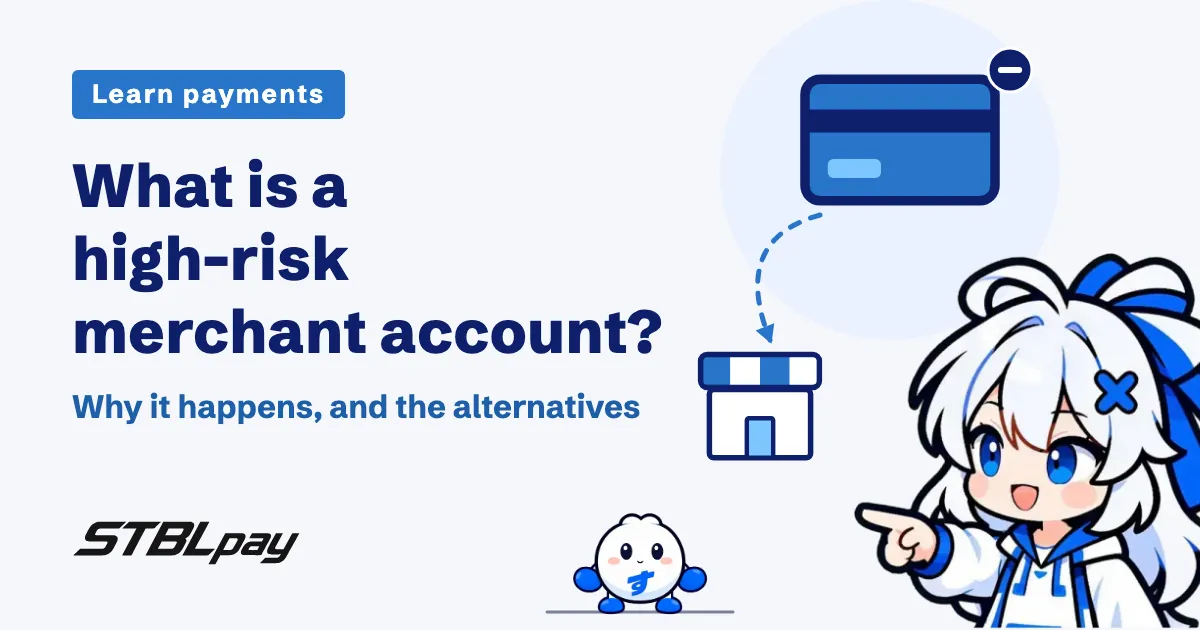
A high-risk merchant account is a card-payment account for a business that its card processor or acquiring bank treats as higher risk than usual. Stripe, for example, says it must follow rules set by card networks and banking partners, so it cannot support some businesses and gives others extra review[1]. This guide explains why a business gets the label, what it can involve, why "instant approval" claims deserve care, and what non-card options exist, including a yen stablecoin for selling to buyers in Japan.
What is a high-risk merchant account?
"High-risk merchant account" is an industry phrase, not a legal term. It usually means a card-payment account at a processor or acquirer that sees the business as carrying more risk than average. Card acceptance runs through card networks such as Visa and Mastercard, and a merchant must keep disputes (also called chargebacks) and fraud at acceptable levels as part of its obligations to those networks[2]. Processors set their own rules on top of the networks' rules, so one processor may decline a business that another accepts. This guide uses public documentation from Stripe and Visa as examples, and other processors may differ.
Why are some businesses classified as high risk?
Public documents point to a few kinds of reasons.
- The industry or product. Stripe keeps lists of prohibited businesses and of restricted businesses. Restricted ones need additional due diligence, and Stripe says that because of card network rules, requirements of financial partners and its own compliance and legal obligations, it might not be able to approve them[1]. Examples on its restricted list include cryptocurrency exchanges and wallets, money transmitters and online dating services[1].
- The business model. For restricted categories, Stripe says it asks for extra information, such as proof of relevant licenses or more details about the business model[1].
- Dispute and fraud levels. If disputes or fraud exceed thresholds set by a network such as Visa or Mastercard, the network places the business in one of its monitoring programs[2]. Visa describes its Acquirer Monitoring Program (VAMP) as one that identifies high-fraud parties[3].
- History. Visa and Mastercard operate databases of terminated merchants, Mastercard's MATCH and Visa's VMSS. Per Stripe, acquirers must screen applicants against them before approval[4].
Where a business falls is up to its processor. If you are unsure, ask the processor which of its policies applies to you.
What does a high-risk merchant account involve?
The public sources describe these things. Which of them applies to you depends on the processor and your agreement.
| Item | What the sources say |
|---|---|
| Extra review | Restricted businesses need additional due diligence. Approval is specific to each service, and Stripe says it may modify or revoke it at any time[1] |
| Reserves | In Stripe's terms, a Reserve is collateral funds that Stripe holds and controls to satisfy liabilities or potential liabilities the user incurs[5] |
| Monitoring programs | Above a network's thresholds, the network places the business in a monitoring program, and monthly fines and additional fees can apply until levels fall in a sustained way[2] |
| Loss of card acceptance | Stripe says that failing to meet a program's requirements within the specified period can result in the network refusing to process further payments, which puts the ability to accept card payments at risk[2] |
| Termination lists | Acquirers report merchants they terminate for fraud, severe policy violations or excessive chargebacks. A listing is a severe industry-wide restriction, as most processors automatically reject listed businesses or principal owners. It stays active for 5 years, and only the acquirer that listed the business can request removal[4] |
Pricing and reserve terms differ by processor and are set in each agreement, so compare the written terms before you sign. We did not find a primary source that gives typical figures, so this guide does not quote any.
Is there "instant approval" for high-risk merchant accounts?
Card acceptance is approved by an acquirer or processor, not by a website that markets accounts, and each one runs its own underwriting. Stripe's documentation shows why a firm promise is hard to give. Acquirers must screen every applicant against the terminated merchant databases before approval[4], restricted businesses may be asked for licenses or business-model details[1], and even an approval can be modified or revoked later[1]. Be wary of any offer that promises sure or instant approval before the processor has reviewed your business. Read the agreement for reserve, fee and termination terms, and ask who the acquiring bank is.
What are the alternatives to card payments?
If cards are not available or not a good fit, the options depend on where your buyers are. Ask a processor which payment methods it supports for your business. Some methods work differently from cards. For example, Stripe says its Konbini method used in Japan does not support the standard dispute process, so customers cannot file chargebacks[6]. For other methods, see our guides on payment methods in Japan, konbini payment and accepting stablecoin payments. Each option has its own terms, limits and eligibility rules, so check them before you rely on one.
| Option | Runs on card networks? | Chargebacks? | Who can pay |
|---|---|---|---|
| Konbini payment | No | Not supported, per Stripe[6] | Customers in Japan[6] |
| Yen stablecoin (STBLpay, under development) | No | No card-style chargeback. Refunds are sent by the merchant | Buyers in Japan with a JPYC EX account |
What if a high-risk business sells to customers in Japan?
Card payments in Japan involve merchant screening too. Japan's Installment Sales Act requires a business that contracts with merchants to handle credit card numbers to investigate a merchant before contracting, and not to contract if what it learns shows that the measures the merchant plans to take to manage card numbers and prevent their fraudulent use do not meet, or may not meet, the Act's standards[7]. Non-card methods have their own eligibility rules. For example, Stripe's Konbini page names business categories that cannot use Konbini[6]. A yen stablecoin is one way to be paid by buyers in Japan that does not run on card networks.
How does STBLpay fit?
STBLpay (すてぶるペイ) is a payment service in which buyers pay in yen and merchants receive JPYC. It is under development, and the launch date has not been set (as of November 2026). It is not a general replacement for a US card account, because it is for selling to buyers in Japan.
- STBLpay does not use card networks, so card-network merchant underwriting and its high-risk categories do not apply. Merchants receive JPYC to their own wallet, and the provider does not hold funds (non-custodial). The service does not rely on card companies' credit screening.
- A merchant account can be opened on the web without prior business screening (KYB) or identity verification (KYC). This is because STBLpay connects the merchant's and the buyer's wallets in a permissionless design, with no step where the provider approves each merchant.
- This is not unconditional. Use requires agreeing to the terms of service, in which the merchant represents that its business is not illegal under Japanese law, and meeting legal requirements. Merchants unsure about their business type are asked to consult before integrating. See the known limitations in the merchant docs.
- Buyers pay in yen from Japan. They need a JPYC EX account, which is available to individuals residing in Japan. They pay by Japanese-yen bank transfer and approve the payment with a passkey (face or fingerprint). If the buyer's JPYC balance is enough, no bank transfer is needed.
- There is no card-style chargeback. Refunds are sent by the merchant.
- The merchant withdraws to yen from its own JPYC EX account, which is available to individuals residing in Japan and Japanese corporations. The provider, Ango-ya LLC, does not hold buyers' or merchants' funds or private keys.
- The fee is a single flat rate for all merchants, and nothing is added on top for the buyer. The rate and what it covers are on our fee page (in Japanese).
This page is general information, not legal advice. Start with the merchant docs, the Quick Start and the Sandbox.
Frequently asked questions
Why is my business considered high risk?
Public documents point to four kinds of reasons: the industry or product, the business model, dispute and fraud levels, and history, such as a listing in a terminated merchant database. Where a business falls is up to its processor, so ask the processor which of its policies applies to you.
Is a high-risk merchant account the same as being on the MATCH list?
No. A high-risk label is a processor's own risk assessment. MATCH is Mastercard's database of businesses that acquirers terminated for severe rule violations, fraud or high chargebacks. Stripe says most processors automatically reject listed businesses, and listings stay active for 5 years.
Can I get a high-risk merchant account with instant approval?
Card acceptance is approved by the acquirer or processor, and each one sets its own checks. Stripe says it asks for extra information such as licenses or business-model details for restricted businesses, and that approval can be modified or revoked. Be wary of any promise of sure or instant approval.
What is a reserve on a merchant account?
In Stripe's terms, a Reserve is collateral funds that Stripe holds and controls to cover liabilities or potential liabilities the user incurs. Other processors have their own terms, so read the agreement of the one you use.
What happens if my chargebacks get too high?
Stripe says that if disputes or fraud exceed a card network's thresholds, the network places the business in a monitoring program. You can incur monthly fines and additional fees until levels fall in a sustained way.
Do card network rules apply to a stablecoin payment?
Card network rules apply to payments made on card networks. STBLpay does not use card networks, so card-network merchant underwriting and its high-risk categories do not apply to it. Its own terms of service and legal requirements still apply.
Is STBLpay a replacement for a US card account?
No. Buyers pay in yen from Japan and need a JPYC EX account, which is for individuals residing in Japan. STBLpay is for selling to buyers in Japan. It is under development, and the launch date has not been set (as of November 2026).
How long does a MATCH listing last?
Stripe says a listing stays active for 5 years, and that only the acquirer that listed the business can request removal.
Sources
Source 7 is in Japanese, and the other sources are in English. Sources 1 to 6 were checked on November 9, 2026. Processor documentation and card network programs change, so check the current page before you rely on it.
- Stripe, "Prohibited and Restricted Businesses" (last updated 2026-09-22; card network and financial partner rules, restricted businesses, additional due diligence, approval can be modified or revoked). Checked on November 9, 2026.
- Stripe, "Dispute and fraud card monitoring programs", Stripe Documentation (thresholds, monitoring programs, fines and fees). Checked on November 9, 2026.
- Visa, "New security program refresh takes aim at payments fraud", Visa Perspectives, May 15, 2025 (Visa Acquirer Monitoring Program). Checked on November 9, 2026.
- Stripe, "Terminated merchant files", Stripe Documentation (Mastercard MATCH and Visa VMSS, screening, listing period, removal). Checked on November 9, 2026.
- Stripe, "Stripe Services Agreement, General Terms" (definition of "Reserve"). Checked on November 9, 2026.
- Stripe, "Konbini payments", Stripe Documentation (customer location, business categories that cannot use Konbini, disputes and chargebacks). Checked on November 9, 2026.
- e-Gov Laws and Regulations Search, "割賦販売法" (Installment Sales Act, Act No. 159 of 1961), Article 35-17-8 (investigation by a business that contracts with merchants to handle credit card numbers). Checked on November 10, 2026 (text read through the e-Gov law data API).